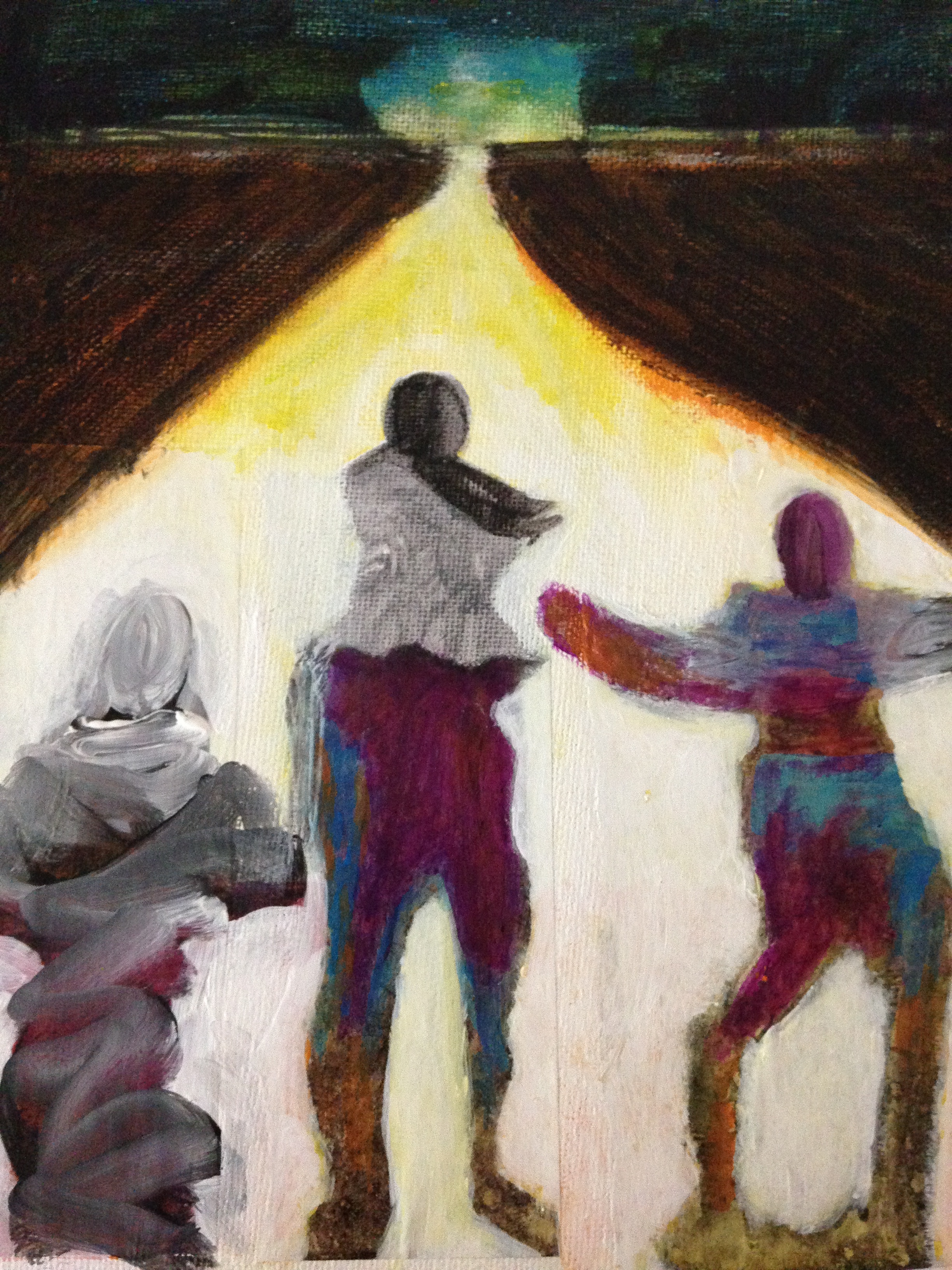
Nothing Good Comes from Inside

How do you handle remaining sin in your life?

What does it look like? It’s what the Apostle Paul talks about in Romans 7:15.

“For I do not do what I want, but I do the very thing I hate.”

And then again in verse 19: White

“For I do not do the good I want, but the evil I do not want is what I keep on doing.”

That pretty much summed up my Christmas vacation.

Stick around long enough with family and friends and eventually you’ll find yourself in Romans 7.

So what’s the solution?

Here it is:

Keep your eyes on the completed work of Christ on the cross for you.

Once that melts your heart, then confess your sins to him.

And don’t look inward for your sanctification – something I do frequently – because it’s not there. You’ll only find a mess.

Glue your sight onto Christ who is your righteousness, sanctification and salvation.

Talk to me.

messychristians@gmail.com


The Rights of Being Wrong

How many times have you valued being right, having the last word, being firm and in control?

If you’re like me, many times.

Has anyone told you that sounds an awful lot like self-love?

We are born legalists. We love law. We delight in being right.

“That’s not fair!” shouts a crying child when another yanks her toy away.

How does a 2-year old know what’s fair? Who taught her? child

Our legal hearts demand what is right and fair. And where does that come from? From God’s law. We’re all born with an innate sense of right and wrong. That’s because God stamped his image on us, and even though we are sinners and live with a distorted view of God, remnants of it are still there like a shattered mirror.

Satan takes full advantage of our dilemma and, as a cunning rascal, pronounces us guilty every chance he gets and demands payment for our sins. And if we’re not watchful, we’ll fall into the trap and believe it’s up to us to fix ourselves.

This can happen a million times a day.

If your thoughts are negative, accusatory, pointing out other people’s faults, blaming others, devaluing the people in your life, dishonoring them, and demanding your rights and your way, you’re listening to the devil.

Resentment and bitterness produce a heavy heart and a broody attitude, all of which indicate you’ve moved away from the gospel – Christ’s righteousness for you.

Remember, Christ showers you with grace and mercy every moment of every day because he’s paid for your sins.

We’re happy and grateful to accept that truth for us, but what’s shocking is he also gives that same grace and mercy to the people around us that are hard to live with!

So instead of resentment and bitterness, let’s give forgiveness and peace; instead of rehearsing our wounds, let’s release them to the Lord at the cross, and walk away; instead of blaming others, let’s talk about our faults first and see what happens. Since the judge of the universe has declared us righteous in Christ, we can be vulnerable with others and not be afraid of their response.

Make these your Christmas presents this month!

Talk to me.

messychristians@gmail.com


Condition Alert!

Have you struggled like me with knowing how to respond to the circumstances in your life? How you’re never prepared really even if you think you are? And how shocking sometimes they can be and you ask yourself the question, “How did I get here?”

Well, you’re not alone. The Apostle Paul faced the same thing, but he didn’t stay stuck there. He learned some valuable lessons. He said, “I know how to be brought low, and I know how to abound. In any and every circumstance, I have learned the secret of facing plenty and hunger, abundance and need. I can do all things through him who strengthens me.” Philippians 4:10-12 ESV

Martyn Lloyd-Jones in his book Spiritual Depression says, Van Gogh2

“Paul had come to learn this great truth by working out a great argument. I think that the Apostle’s logic was something like this. He said to himself:

“1. Conditions are always changing, therefore I must not be dependent upon conditions.

“2. What matters supremely and vitally is my soul and my relationship to God – that is the first thing.

“3. God is concerned about me as my Father, and nothing happens to me apart from God. Even the very hairs on my head are all numbered. I must never forget that.

“4.God’s will and God’s ways are a great mystery, but I know that whatever he wills or permits is of necessity for my good.

“5. Every situation  in life is the unfolding to some manifestation of God’s love and goodness. Therefore my business is to look for this peculiar manifestation of God’s goodness and kindness and to be prepared for surprises and blessings because ‘His ways are not my ways, neither His thoughts my thoughts’. What, for example, is the great lesson that Paul learned in the matter of the thorn in the flesh? It is that, ‘When I am weak than I am strong’. Paul was taught through physical weakness this manifestation of God’s grace.

“6. I must regard circumstances and conditions, not in and of themselves therefore, but as a part of God’s dealings with me in the work of perfecting my soul and bringing me to final perfection.

“7. Whatever my conditions may be at this present moment they are only temporary, they are only passing, and they can never rob me of the joy and the glory that ultimately await me with Christ.”

It took Paul a lifetime to learn this and it will take that long for you and me, too, but we can trust God to teach us this secret of contentment while the chaos swirls around us.

Talk to me.

messychristians@gmail.com


Mind the Gap

If you’ve been to London and taken the tube you’ve heard the recording that says, “Mind the Gap” that comes on at every stop. It’s a mantra. That’s because there is a space between the subway car and the platform large enough to lose a shoe in. I’ve seen it happen.

The idea of a gap between two realities is also prevalent in the bible, and it’s not a tiny space like the London tube. It’s immense. It’s as large as earth to Mars, only bigger. It’s the tension of the now and not yet. We are saved now but the reality of its fullness is not ours yet. That comes when Jesus returns or we die and go to be with him, whichever comes first. photo (8)

We see this tension fleshed out in the story of Abraham and Sarah in Genesis 16. Here we see Sarah’s impatience with God to give her a son, so she takes matters into her own hands by suggesting to Abraham that he sleep with Hagar, her maid, and produce the child that way, something that Abraham did not resist, by the way.

We see Sarah’s struggles with God’s timing, which reveals Sarah’s doubt of God’s character. Why is he taking so long? It’s been ten years already and nothing’s happened. Can I continue to trust him? Underneath it all is a suspicion of God’s goodness. Can’t you hear the same echos of the devil saying the same thing to Eve in Genesis 3?

Here we see Abraham and Sarah living in the gap between what God had promised and their unfulfilled expectations.

I see this played out in my life and in the lives of family and friends. We long for close, intimate and satisfying relationships. Instead we live with distance, misunderstandings, and heartache. We long for satisfying work. Instead we grumble and complain because of the boredom. We want glory here and now, but God says not yet, it’s coming soon.

What can we learn from this? Here are three insights:

1) Living in the gap of the now and not yet tempts us to take matters into our hands. The underlying assumption is that we can fix the problems ourselves like Abraham and Sarah did. But instead of fixing things, we make a mess of things.

2) While living in the gap, we continue to be faithful to what God has called us to. We trust God’s faithfulness. That doesn’t mean we take no action, but it does mean we do things believing God is for us and not against us.

3) God doesn’t go AWOL in the gap and in our messes. He doesn’t flee to heaven and wait for us to figure out ways to make it home. If he did that, nobody would get home. He’s there working in the gap. He’s a God who sees and hears and is in the middle of the mess. That’s what he has promised to do. And ultimately he will fulfill all his promises to us. We don’t know how or when, but it will happen.

You won’t lose God in the gap. There is joy, freedom and laughter there if we trust him for the reality that’s coming.

Question: What are some of the ways you take matters into your hands while living in the gap?

Talk to me.

messychristians@gmail.com



Help for a Struggling Prayer Life

If you’re like me, you struggle with your prayer life.

I go from faith to unbelief every day.

It’s an all out war that wages in my mind.

God calls me to prayer, I pray, and then I don’t expect anything to happen.

That’s disgusting.  photo(199)

It’s also sin. It disgraces God who tells me he’s the God who hears prayer – Psalm 65:2.

So what do I do about it?

I need to understand God better.

God is not a Buddha statue who dispenses favors for the best tummy rub.

Nor is he a short-order cook writing down my laundry list of wants.

He’s also not a jolly grandpa in a rocking chair waiting to indulge me.

He’s God Almighty, the maker of heaven and earth, who, if I am his child in Christ, is my Heavenly Father, and as such he pledges to be my Covenant God.

What does that mean?

It means that God is ready to hear my prayer, like a father is eager to hear what his son has to say.

He is ready to hear and grant my prayers.

My problem is that I may not perceive his answers.

By giving me a heart to pray and inflaming my desire to pray is an answer to prayer. Psalm 138:3

Also, I do not pray alone. Christ, my mediator, prays over my prayers. He takes the dross out of my prayer and presents it as pure gold to the Father, making my prayer powerful and mighty.

Just like a farmer who sows seed into the ground and then waits for the harvest, my prayers are the seeds I sow in faith and I wait in anticipation for God to send me a harvest of blessing, knowing he has heard and acknowledged each prayer.

If I remind myself of these truths, I have hope my prayer life will improve and the Lord will be pleased with me.


Are You Singing?

A friend of mine has been asking lately what the difference is between a true Christian and a false one.

My answer is simple. A true Christian is someone who believes in Christ alone, through faith alone, by grace alone.

But my friend continues to ask, “But what about the evidence in his life?”

What of it? grape vine

James says, “Faith without works is dead.” And God says the greatest work is to believe in His Son whom He has sent into the world so all men may be saved.

Then they said to him, “What must we do, to be doing the works of God?” 

Jesus answered them, “This is the work of God, that you believe in him whom he has sent.” – John 6:28, 29 ESV

So if you believe that Jesus Christ is your Savior who died on the cross to pay the price for your sins, then this is counted as a good work in God’s eyes. In fact it’s the greatest work because without faith it is impossible to please God.

John 15 says, if you are a branch that is united to the vine, then you will show forth good fruit. Have you ever seen a branch huffing and puffing and sweating to produce grapes?

The same is true of you. As a Christian you are doing good works all the time, but most of the time you won’t see them because you’d be tempted to pride. But God sees them and He is pleased with you because you are in Christ. See Romans 6. Ephesians 1 & 2.

And remember, all your works are tainted with sin, even good things like prayer, witnessing, giving to the poor. They all must be mediated by Christ in order for God to accept them.

So I told my friend to stop worrying and start singing.

You do the same.

Are You Perplexed About God’s Will?

If I were God, and I wanted to get my message to the people I’ve created, I certainly wouldn’t put my best men in prison for years, mistreat them, put them through hurdles, and even kill my best man on the job.

But that’s exactly what God did with Elijah, Moses, Abraham, David, Paul, Peter, John, and of course, Jesus.

“I know, O LORD, that the way of man is not in himself, that it is not in man who walks to direct his steps.” – Jeremiah 10:23 ESV 

That’s an understatement.

It is my experience that God leads and directs in mysterious ways.

The things I most pray for don’t come to fruition in the way I ask.

In fact, oftentimes God keeps me waiting or answers me in opposite ways.

And his answers can be risky and perplexing. They make me ask what God is up to.

They also produce fear in me, and then I realize I can’t fix the outcome, and then I am forced to trust him.

I am no longer in control.

Martin Luther experienced the same thing.

“We need to learn how God guides his people as they grow and develop. I too have often tried to dictate to our Lord God a certain way in which I expect him to run things. I have often said, ‘O Lord, would you please do it this way and make it come out that way?’ But God did just the opposite, even though I said to myself, ‘This is a good suggestion that will bring honor to God and expand his kingdom.’ Undoubtedly, God must have laughed at my so-called wisdom and said, ‘All right, I know that you are an intelligent, educated person, but I never needed a Peter, a Luther, or anyone else to teach, inform, rule, or guide me. I am not a God who will allow himself to be taught or directed by others. Rather, I am the one who leads, rules, and teaches people.'”

I am reminded that since God is taking care of every detail of the universe, surely he will take care of me.

I am learning to rest in that truth.

How To Thrive After Being Crushed by the Church – Part 1

Are you someone who has grown up in church where performance defined who you were?

Where most days you were a miserable failure?

And love and acceptance were foreign concepts?

I have good news for you.

You didn’t grow up with the gospel.

You grew up with moralism (law).

The law is harsh. It beats you up. It tells you what you must do in order to please God (and others), but has no power to help you get there.

So you looked at your life and said, “I can’t do this,” and got depressed.

Or you admitted your failure, got furious, and walked away.

Here’s what happened to you.

You came into the church by faith in Jesus. He loved you so much he died for you. And you accepted his gift of salvation with gladness.

Then week after week you listened to preaching about moral behavior and living, and in a flash you plunged into despair because you didn’t measure up.

Your joy in Jesus went up in a puff of smoke. You even went so far to say that this Christian thing doesn’t work.

If you can relate to this, then here’s a question to ask yourself:

Is the cross and blood of Jesus sufficient to save you even while you are still sinful? Even while you continue to fail at living the Christian life?

You know what?

Heaven is filled with Christian failures! There aren’t any other kind of people there!

Jesus’ death on the cross and his shed blood for you is all you need.

Jesus himself will welcome and embrace you!

How’s that possible? It’s because God has given you the gift of the righteousness of Jesus. You had it the moment you came to faith.

It’s the only performance that counts!

Grab a hold of it and never let it go!

How To Have a Silent Conversation

I spend a lot of time counseling people with problems. The nature of what I do requires a fair amount of talking. Giving counsel and encouragement has become a way of life for me over the years.

Every once in a while however, something different happens. Like today.

Polly calls me every month. She is a woman with learning disabilities. She admits to not being able to follow directions or retain information. Consequently she’s unable to hold down a job.

Today was another one of those calls.

She told me she was being evicted and needed another place to live.

She exhausted that theme, and then launched into describing the conflicts she was having with her older sister.

She spoke for twenty minutes.

When she finished, I prayed for her.

“Thank you. You are a delight to talk to,” Polly said and hung up.

I smiled.

I had said nothing to her. All I did was listen.

And then this thought came to me, maybe from the Holy Spirit.

“You showed more grace and love in your listening than anything you could have said.”

It made me think.

Perhaps the Lord would make more of an impact on people through my silence.

Most people don’t want to be fixed.

They want to be loved.

What do you think? Leave me a comment.

How To Love Difficult People

At her husband’s funeral, the widow says to her adult daughter, “Your father and I would have had a wonderful marriage if only he had been someone else.”

Let’s be honest. We’ve all had those thoughts.

Your life would be so much nicer if you had a better spouse, kids, parents, boss, friends, and neighbors.

The old saying is true:

The problem with the world is the people!

All of us live with difficult people.

The trick is how to do that well.

Some difficult people are sincere Christians who love the Lord Jesus and mean to do good.

But they’re lacking in self-awareness, sensitivity toward others, discipline, or some other quality that would make your life easier.

Then there are those whose habits and quirks drive you nuts. Eating with a full mouth. Burping. Not listening. Being too loud.

What does God tell us to do?

To suffer long with them and to be kind.

What you don’t want to do is use the law. To tell them to change. To demand that they change.

Instead, remind yourself of the gospel.

You are a difficult person, too.

And yet God loves you, forgives you, shows his mercy and patience toward you.

That’s reason enough to show the same to others.

And one day, when Jesus returns, all of us will be perfect!